Uomaru
When you walk out of Hikone station, you’re faced with a bewildering choice of eateries lining the road to the castle. One of these is Uomaru, an izakaya-style restaurant whose first character ‘uo’ means ‘fish’, reflecting the particular focus of the establishment. I went for dinner on a warm summer night when the French windows facing the street were open and locals were dropping in.
Urabe Toshiharu the manager showed me to a counter seat overlooking the busy kitchen. Uomaru has a range of seating, with open tables, booths, and private rooms upstairs. With its wooden furniture and tightly aproned staff, the restaurant somehow resembles a Wild West saloon, in spite of the shamisen background music.
{embed="common/_image" src="20201007-095932102.jpg" caption="" class="h"}
Since Shiga is landlocked, I’m curious about where the fish comes from.
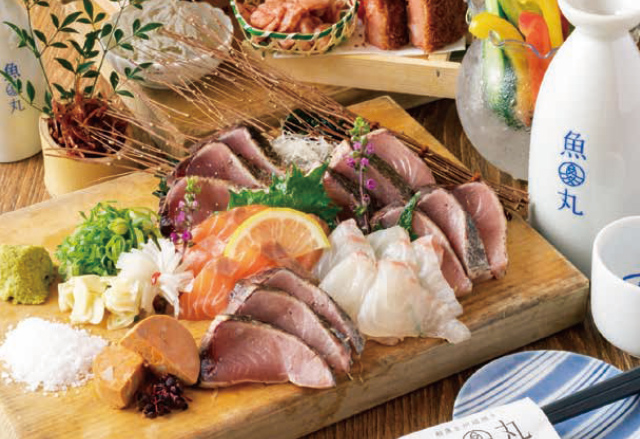
“A lot of our fish is landed from the Japan Sea at Kyōto and Fukui. But one of our specialties is authentic katsuo no tataki. For that we have bonito tuna delivered from Kōchi. Katsuo no tataki is made by searing outside of the fish over flaming rice straw. Because the straw burns at high heat, the edges of the fish become crispy, and the aroma of the straw adds a savoury note to the tuna.”
“Do you use any fish from the Ōmi region?”
“Yes, we serve wild Biwa trout. The season for trout is nearly over now.”
Urabe-san brings a wooden tray laden with various sashimi on a bed of ice with garnishes of sliced vegetables and edible leaves. It’s a wonderfully colourful sight.
The young serving lady brings a bottle of dry Kirakuchō sake.
“Although it’s dry, it has a fruity character that complements sashimi nicely.”
Throughout the meal, she provides these handy little commentaries on the sake. It’s a joy to have well-informed service.
The sashimi platter includes fish with varying degrees of oiliness – the salmon is very rich indeed, while the Biwa trout is light and delicate. Both match the recommended sake perfectly.
{embed="common/_image" src="20201007-095933089.jpg" caption="" class="h"}
On the other side of the counter, the chef is readying some katsuo no tataki. In quality restaurants, this is always prepared directly before serving. The fillets of tuna are arranged on a rack and the straw is lit. Tall flames rise up and the flames are fed in turn by the sizzling oil that drips from the fish. A wonderful aroma wafts my way. Meanwhile, the server has more sake recommendations, and this time there’s a choice – Kure, from Kōchi where the tuna comes from, and a Daijirō kimoto. “Kure is brewed specifically to go with seared tuna, but Daijirō from Ōmi happens to have a similar profile. It’s a difficult choice. Maybe a cup of each?”, suggests Urabe-san. Strange to say, but the local Daijirō seems to go best with the succulent, smoky tataki topped with a little sliced garlic. It’s a sublime match.
Where possible, Uomaru uses locally sourced ingredients. The next dish, lightly fried burdock sticks with mayonnaise, is produced nearby. Before frying, the burdock is tenderised by simmering in a light stock. This too is a perfect companion to sake. I catch the eye of the young cook in the kitchen who prepared the burdock, and smile him my complete satisfaction. He beams back.
“The menu seems to feature a lot of fish. Do you offer anything else?”
“Yes. Although our main focus is high-quality fish, we have enough alternatives to satisfy anyone, including Ōmi beef dishes.”
In addition to the wonderful izakaya food, you can enjoy the little design elements that make the Uomaru brand, from the fish in a circle logo to the amusing graphics on the glasses that celebrate Japan’s izakaya culture.
Related Articles
Hikone Castle Yakatabune Cruise
Hikone Castle was completed in 1622 as the seat of the Ii family. The peaceful Edo period began in 1603, and although Hikone Castle was built for war, the succession of Ii lords enjoyed a bucolic existence in their castle and its palace. Thanks to the energetic service of Ii Naomasa, the first lord of Hikone, at the Battle of Sekigahara in 1600, the Ii family became the most trusted vassals of the Shogunate in Edo.
When Hikone Castle was finished, it sat at the centre of a huge complex of moats and lakes that were joined with nearby Lake Biwa. It’s not surprising that the lords of Hikone spent some of their leisure time boating on these pleasant waterways. The lords rode in yakatabune, elegant wooden boats with a low roof to provide shelter. They were usually powered by a single large oar that extended from the back of the boat.
{embed="common/_image" src="20200723-112248389.jpg" caption="" class="h"}
Today the castle has only two moats, and the big subsidiary lake northeast of the castle was filled in long ago. But you can take a ride in a yakatabune on the inner ring of the moat. The boats are powered by very quiet electric motors, so you can easily hear what the English-speaking guide is saying. Swans that live in the moat glide up to the boat and are greeted by name by the boatman.
As you make your way around the moat, you slide under a couple of bridges with little room to spare. Various defensive features reveal themselves, such as the stone walls that climb the steep slopes of the hillside to prevent attackers from moving freely around the hill. There’s a water gate where rice stored by the Shogunate was loaded and unloaded. At intervals, the ornate tower of the castle reveals itself between the trees.
When the boat comes to a weir and turns around, the guide explains that today the moat is higher than the water level of Lake Biwa, which is controlled by dams, so it’s no longer possible to head out into the lake.
{embed="common/_image" src="20200723-112248846.jpg" caption="" class="h"}
In the Edo period, the feudal lords were required to go to Edo every two years. The lord of Hikone was on very friendly terms with a lord from Kyūshu, and to spare his friend the long walk around Lake Biwa, the lord of Hikone would pick him up by boat and enjoy the cruise with him to the north of the lake. At such times, the number of oars could be increased to four, turning the yakatabune into an Edo version of a speedboat.
This is a very pleasant way to finish a visit to the castle. Whatever the season, there’s something different to enjoy. A gentle cruise around the moat in the manner of a feudal lord is an experience you should try at least once.
Ōmi Sake
Shiga Prefecture has a lot of sake breweries for its size, many of which fall into the Ōmi region. These are typically small, family-run breweries that produce small volumes of high-quality sake. The sake produced by each brewery has its own personality, and each brand has its loyal devotees.
Rather than competing, the brewers work and study together to improve their skills and knowledge, to raise the level of their sake in general.
Shiga Prefecture is a vast basin, with Lake Biwa occupying one sixth of its area. This basin is surrounded by the Ibuki and Suzuka mountains in the east, and the Hira and Hiei mountains in the west. Snowmelt and rainwater percolates down from the mountains, appearing everywhere throughout the region as pure rivers and springs. This water is ideal for brewing sake.
Not incidentally, this abundant water is also perfect for cultivating sake rice. Ōmi has been known as a major rice production area since ancient times, and some of this production was dedicated to types that are particularly suitable for brewing sake. The ancient tradition of brewing sake here is reflected in the fact that one of Ōmi’s breweries, Fujii Honke, enjoys the honour of providing the ceremonial sake used by the Imperial Household and Shintō shrines nationwide.
Four main types of sake rice are used for brewing sake in Ōmi: Yamadanishiki is used nationwide, including in Ōmi. It’s particularly good for brewing ginjō style sake, and it’s popular with brewers for its reliability in the various stages of brewing. Tamasakae is well suited to brewing clean, dry sake. Ginfubuki is a combination of Yamadanishiki and Tamasakae. Shiga Wataribune No. 6 is said to be the progenitor of Yamadanishiki.
Shiga Wataribune No. 6 is one of the ancient Japanese varieties that is the progenitor of Yamadanishiki, but it fell out of use about half a century ago and became a rarity.
However, in recent years, the local agricultural cooperative, JA Green Ōmi, decided to revive it in a move to establish a regional brand. Starting with only about 50 grams of seeds received from the Agricultural Technology Promotion Center in Ōmihachiman, the cooperative re-established Wataribune as a production rice through repeated trial cultivation. It’s now prized as a variety that’s unique to Shiga Prefecture.
The quality of this newly viable Shiga Wataribune is on a par with Yamadanishiki, and the rice is now used in several breweries in Shiga.
The third component essential for sake, yeast, is also produced locally. Yeast breaks down the sugars in rice to produce alcohol, carbon dioxide, and amino acids. Over 200 yeast strains that live in breweries in the region have been collected, selected, and crossed to arrive at a taste that’s dry but refreshing, which drinkers never tire of drinking.
Ōmi sake and food pairing
Lake Biwa, Japan’s largest lake, has many varieties of freshwater fish which are delicious paired with sake. Ōmi sake, which emphasises the umami of rice, makes an excellent match with the mild taste of freshwater fish, while the robust flavour of yamahai and kimoto styles complement the richness of Ōmi’s premium beef.
Since winters in Ōmi are typically cold with considerable snowfall, it’s no surprise that the region’s sake is also perfect served warm. Even in spring and autumn, a flask of warm sake can be very comforting. Try experimenting with sake heated to various temperatures, or visit one of the excellent local bars or restaurants to have your sake heated to the perfect warmth for each type.
Some examples of food pairings are shown below.
Carp with its eggs
{embed="common/_image" src="omi-sake-02.jpg" class="h"}
Carp sashimi sprinkled with its own eggs. This dish always features in the spring festivals of Ōmi. A robust sake, served warm, enhances the delicate richness of the sashimi.
Funazushi
{embed="common/_image" src="omi-sake-03.jpg" class="h"}
Funazushi served with its fermented rice known as ‘ii’, seasoned with chopped chives. The unique harmony of rich, salty and sour keeps drinkers busy pouring one cup after another. Yamahai and kimoto styles go particularly well.
Stewed beans and shrimp
This dish is unique to the region. Soybeans are stewed with the little shrimp from Lake Biwa. A fragrant ginjō offers a nice counterpoint to the homely taste of stewed beans.
Small sweetfish tempura
Ayu from Lake Biwa remains small even as an adult. In early spring, these little fish are coated in crispy batter and eaten with salt for a delicately fragrant snack. It goes best with a crisp, cold sake.
Stewed carp with their eggs
Carp stewed in a sweet, spicy sauce, served with Japanese pepper. A slightly matured junmai served warm is the best match.